
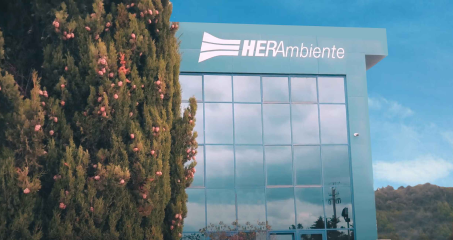
New energy at the Tre Monti site
25/03/2026

The project for the new photovoltaic park within the Tre Monti industrial complex in Imola (BO) was unveiled today; it is set to become a flagship example of environmental regeneration and shared energy production. The initiative, promoted by Herambiente in collaboration with the Municipality of Imola and the Renewable Energy Community (REC) Cooperativa Circondario Imolese, marks a new phase for a historic site dedicated to waste management, where waste reception ceased at the end of November 2024. Tre Monti will offer a new form of service for the community: the production of shared clean energy.
The project
The project forms part of the wider environmental restoration plan for the Tre Monti site, owned by Con.Ami. The photovoltaic system will be installed by F.lli Franchini, a subsidiary of Hera Comm, on the roof of the mechanical-biological treatment (MBT) plant. Work is scheduled for June and July, with the aim of testing the infrastructure by the end of the summer. The project will transform an existing infrastructure into a source of renewable energy across an area of approximately 7,000 square metres, without further land consumption.
The total investment, funded by Herambiente, is close to one million euros and will deliver significant environmental benefits, such as a reduction of over 300 tonnes of CO₂ each year, a total saving of around 9,050 tonnes of CO₂ over 30 years, and an impact equivalent to planting over 22,600 trees.
Renewable energy for the local area
The plant will have a total capacity of 999 kWp and will consist of 2,147 state-of-the-art photovoltaic modules. Estimated annual production is over one million kWh, equivalent to the energy needs of around 350 households. The energy produced will be shared through the REC Cooperativa Circondario Imolese, contributing to the development of a participatory and sustainable energy model. Priority for joining the REC will be given to residents along the access roads to the Tre Monti plants, who will be informed via a dedicated letter.
An energy community for the future
The project is closely linked to the development of the REC Cooperativa Circondario Imolese Energy Community, established in 2024 with the aim of promoting a fairer, more sustainable and more inclusive energy system. The REC represents not only an environmental opportunity, but also a social one: it aims to tackle energy poverty, redistribute economic benefits and improve citizens’ quality of life.
The future of the Tre Monti site
At the Tre Monti plant site, in addition to the mechanical biological treatment (MBT) plant, there was a landfill for non-hazardous waste, which ceased operations in November 2024. Following the settling period required by law, work began on the construction of the final cover, consisting of a multi-layered system of natural and geosynthetic materials capable of isolating the waste, reducing leachate and containing emissions.
The redevelopment process will continue in 2028 with the implementation of the Environmental Restoration Plan, which includes: the creation of a grass cover with a variety of plant species; the planting of shrubbery; and the enhancement of existing rows of Mediterranean cypress and native tree and shrub species, to promote biodiversity and landscape quality.
“Today we are writing a crucial chapter in the energy and environmental future of our region, made possible thanks to the collaboration with Herambiente and the REC Cooperativa Circondario Imolese,” emphasise the Mayor of Imola, Marco Panieri, and the Deputy Mayor and Councillor for the Environment, Elisa Spada. We are returning to the community an area capable of producing energy to meet the needs of 350 households and significantly reducing CO₂ emissions. Through REC, the energy produced becomes a collective asset. We wanted to prioritise residents living in the areas adjacent to the plant: this is a gesture of consideration towards those who have lived alongside the site’s operations over the years. With the Tre Monti solar farm, we are demonstrating that the energy transition is a shared journey: it generates value in the present and the future. We are redesigning a development model in which energy once again becomes a driver of well-being for people. Environmental sustainability and social cohesion can go hand in hand.”
“The Tre Monti plant site,” says Andrea Ramonda, CEO of Herambiente, “has always served the Imola community and the wider region. The construction of the photovoltaic plant represents a natural evolution of this function: a transformation that allows us to continue generating value for the region, today through the production of renewable energy and the sharing of benefits within the Circondario Imolese Renewable Energy Cooperative. This project is fully consistent with the principles of environmental sustainability that guide the Hera Group’s industrial decisions: the plant utilises already sealed surfaces, without any new land take, and reinforces a development model that prioritises the balance between the environment, the local area and local communities. Furthermore, the direct involvement of a Group company, F.lli Franchini, demonstrates the commitment to leveraging internal expertise and established supply chains, helping to build a solid, shared project rooted in the local area.”
“The Imola District Cooperative Energy Community is demonstrating today, through this collaboration, that the energy transition can truly be built at a local level,” adds Mirco Mongardi, chairman of REC Coop Circondario Imolese. “I would first of all like to thank the Municipality of Imola, which promoted and supported the launch of this project, playing a fundamental role in bringing together the energy and expertise of the local area. Hera’s entry as a third-party producer, through the provision of a plant with these specific characteristics, significantly strengthens our capacity to generate shared renewable energy and expands the impact of the energy community. This is an important step because it brings together two fundamental elements: on the one hand, the active participation of citizens, cooperatives and social organisations; on the other, the contribution of a major energy operator. This is the model we want to develop: an open, inclusive and growing energy community, capable of producing tangible benefits for the local area and accelerating the ecological transition.”